
Candle Making Safety Rules You Must Follow at Home


Melted wax reaches temperatures well over 180°F (82°C). That turns your kitchen stove into a serious fire hazard if you treat it like baking a batch of cookies.
Many beginner crafters jump right into pouring candles without realizing the hidden hazards.
Without a clear plan, simple mistakes lead to severe skin burns, shattered glass, or chemical fires. Knowing proper candle making safety rules protects your home and keeps your craft enjoyable.
You do not need an industrial lab to melt wax safely. But you do need the right gear, basic thermal controls, and proper containers.
This step-by-step guide covers essential protective equipment, heating limits, and exact steps to handle unexpected flame flare-ups.
So here are candle making safety rules you must follow at home with complete peace of mind.
1. Set Up Your Workspace and Gear Up for Safety
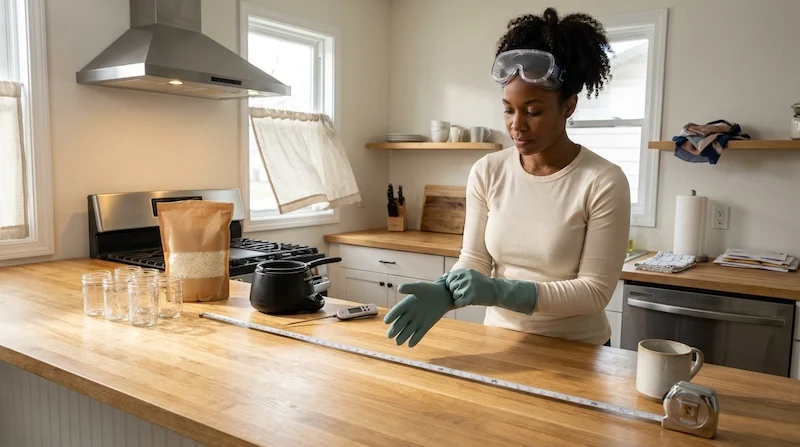
Before melting your first wax block, inspect your physical work zone. Clear away paper, towels, cardboard, and curtains within a 3-foot radius of your heat source. Liquid wax spills quickly and clings to nearby flammable materials.
Your personal gear acts as your first line of defense against accidental splatters. Always complete your candle making PPE checklist before turning on the heat:
- Eye Protection: Wear splash-resistant safety goggles. Hot wax pops when tiny water droplets get trapped inside a melting pot.
- Hand Protection: Use heat-insulating silicone gloves or heavy leather work gloves. Thin cotton oven mitts absorb hot liquid instantly.
- Body Protection: Put on 100% cotton long-sleeve shirts and long pants. Synthetic fabrics like polyester melt into skin when hit by 180°F wax, causing severe burns. Cotton gives you critical seconds to strip off spilt clothing.
- Footwear: Wear closed-toe shoes. Dropping a hot pouring pitcher on bare feet causes immediate harm.
- Hair & Clothing: Tie back long hair and tuck in dangling apron strings.
Good air circulation is just as crucial as protective clothing. Fragrance oils release heavy organic vapors when mixed into warm wax.
Always turn on your stove range hood or open two windows to create a steady cross-breeze. This simple workspace setup keeps your lungs clear of harsh chemical buildup.
Pre-Pour Safety Checklist
- [ ] Clear all paper and fabrics 3 feet away from your stove.
- [ ] Put on safety goggles and 100% cotton long sleeves.
- [ ] Turn on your kitchen exhaust fan.
- [ ] Secure long hair and remove hanging jewelry.
2. Master Wax Heating Limits and Flash Points
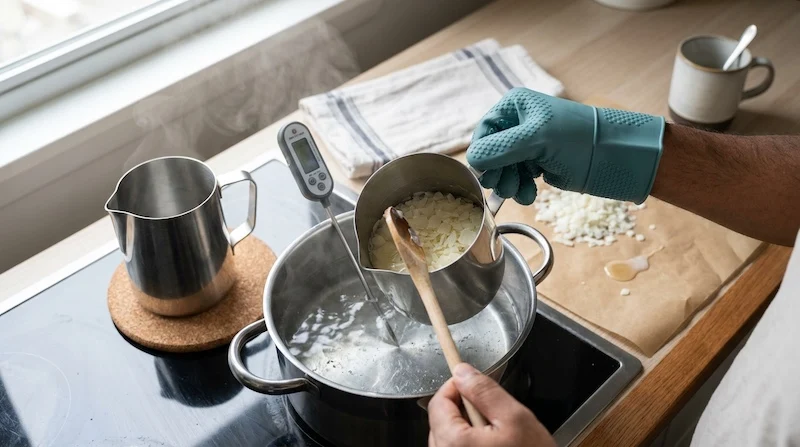
Direct heat is your biggest hazard during production. Critical Rule: Never place a wax pitcher directly onto a stove burner or hot plate.
Unbuffered direct heat creates hot spots over 400°F (204°C) at the bottom of your pot within minutes.
Always use a water-bath double boiler or a thermostat-controlled electric wax melter. A double boiler caps your heating container at 212°F (100°C) because water cannot exceed its boiling point.
[ Stove Burner / Hot Plate ]
           │
           ▼
 [ Outer Pot with Water ]  ◄── Boiling water caps temp at 212°F (100°C)
           │
           ▼
 [ Inner Pouring Pitcher ] ◄── Wax melts gently without hot spots
Every wax type has a flash point. This is the exact temperature where wax vapors become self-igniting. If wax reaches its flash point, it bursts into flames without needing a direct spark.
| Wax Type | Safe Melting Temp Range | Pouring Temp Range | Average Flash Point |
| Soy Wax | 160°F – 185°F (71°C – 85°C) | 130°F – 140°F (54°C – 60°C) | 500°F+ (260°C+) |
| Paraffin Wax | 150°F – 180°F (66°C – 82°C) | 160°F – 170°F (71°C – 77°C) | 375°F (190°C) |
| Beeswax | 145°F – 165°F (63°C – 74°C) | 155°F – 165°F (68°C – 74°C) | 400°F (204°C) |
| Coconut Wax | 120°F – 140°F (49°C – 60°C) | 120°F – 135°F (49°C – 57°C) | 350°F (177°C) |
Never guess your wax temperature by looking at it. Keep a digital probe thermometer or candy thermometer in your melting pot at all times.
Laser infrared thermometers read only the top surface skin, which can stay 20 degrees cooler than the liquid below.
Continuous deep-probe monitoring is one of the most vital candle making safety rules. Check this wax melt flash point guide whenever trying a new blend.
3. Mix Fragrance Oils and Additives Safely
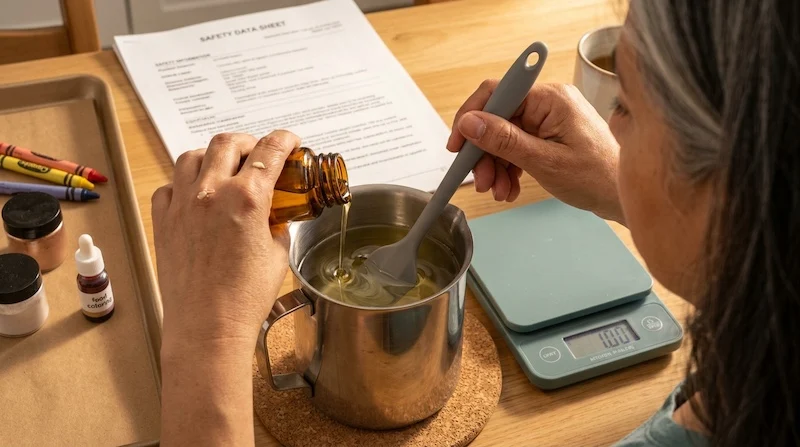
Fragrance oils carry lower flash points than raw wax. Adding oil to ultra-hot wax causes scent compounds to smoke off instantly or catch fire.
Always check the Safety Data Sheet (SDS) provided by your fragrance supplier. Most manufacturers recommend a maximum fragrance load of 6% to 10% by weight.
Adding too much oil creates “sweating.” The excess oil separates from the cooled wax, creating puddles of liquid fragrance on top of your candle. This raw oil ignites instantly when hit by a match flame.
The Off-Heat Scent Protocol
- Heat your wax to the target blend temperature (usually 185°F for soy).
- Remove the pouring pitcher completely from your heat source.
- Place the pitcher on a heat-resistant pad.
- Pour in your measured fragrance oil slowly while stirring gently for 2 minutes.
Avoid using unsafe household items as colorants or scents.
       [ UNSAFE ADDITIVES ]              [ SAFE ALTERNATIVES ]
 ┌───────────────────────────────┐ ┌───────────────────────────────┐
 │ ✖ Crayons (Clogs wicks)       │ │ ✔ Liquid Candle Dyes          │
 │ ✖ Food Coloring (Water-based) │ │ ✔ Wax Dye Blocks              │
 │ ✖ Fresh Botanicals & Dried Leaves│ │ ✔ Candle-Tested Fragrances    │
 │ ✖ Synthetic Perfumes          │ │ ✔ High Flash-Point Essential Oils│
 └───────────────────────────────┘ └───────────────────────────────┘
Crayons contain clay binders that clog wicks. A clogged wick traps heat, raises core temperature, and causes irregular flare-ups.
Fresh botanicals, dried leaves, or spices act like secondary wicks when burned, turning a quiet candle into an uncontrolled flame. Stick strictly to safe candle additives designed for wax.
4. Pick Safe Containers and Stop Thermal Shock
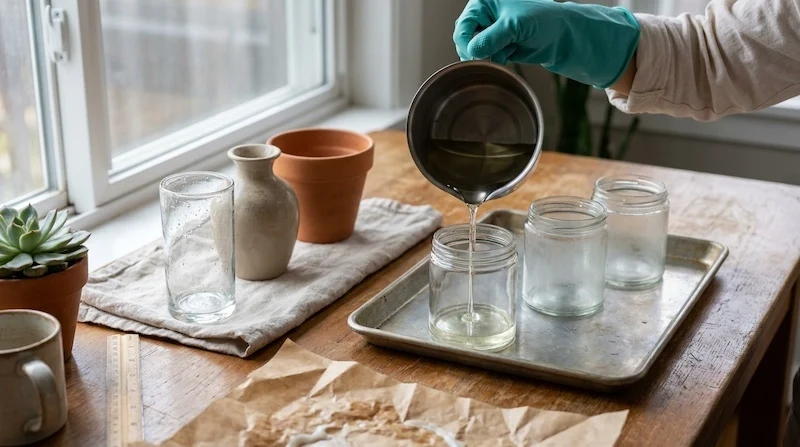
Not all glass jars can handle candle flames. Standard drinking glasses, thrifted vases, and food jars often contain tiny trapped air bubbles or uneven wall thicknesses.
Under the sustained 140°F (60°C) heat of a melt pool, non-candle glass cracks, splits, or shatters across your table.
Always choose candle safe containers built to meet ASTM F2179 standards. These include:
- Annealed soda-lime glass jars made specifically for candle making.
- Seamless metal tins with raised bottoms.
- Glazed, non-porous ceramic vessels.
Avoid porous terracotta, untreated wood, or plastic pots. Wax soaks deep into unglazed clay, transforming the vessel itself into a fuel source.
Cold Jar (70°F) + Hot Wax (175°F) = HIGH THERMAL SHOCK RISK (Crack!) Preheated Jar (100°F) + Hot Wax (175°F) = SAFE POURING ENVIRONMENTGlass breaks when it experiences a sudden temperature shift of more than 90°F (50°C) across its surface. This is called thermal shock.
To prevent thermal shock candle pouring, warm your jars using a heat gun on its lowest setting or set them on a baking sheet inside a warm oven set to 100°F (38°C) before filling. Warm glass helps wax set evenly without cracking your jars.
5. How to Handle a Wax Fire Emergency
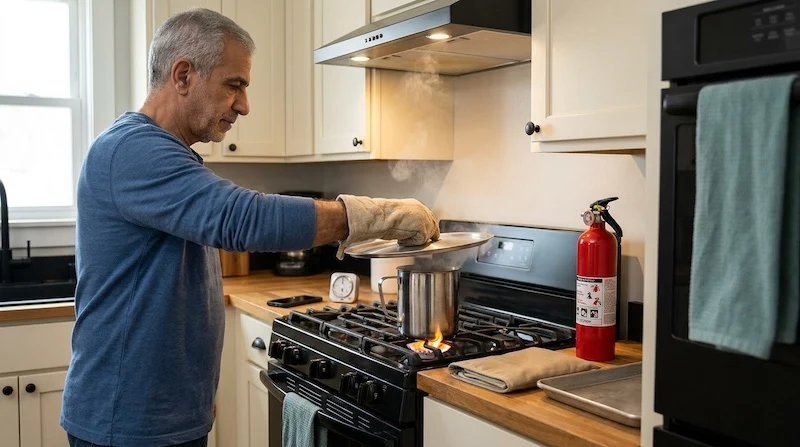
A wax fire behaves exactly like a kitchen grease fire. The absolute golden rule of wax safety is simple: NEVER POUR WATER ON A WAX FIRE.
Water drops sink below liquid wax, vaporize instantly into steam at high heat, and expand 1,700 times in volume. This sends a massive column of burning wax into the air, creating a dangerous fireball explosion.
Follow this 3-step wax fire emergency response if your pitcher catches fire:
- Cut the Power: Turn off your burner, hot plate, or electric melter immediately if you can reach the dial safely.
- Smother the Flame: Slide a metal pot lid, flat baking sheet, or fire blanket directly over the pitcher. Cut off oxygen to kill the flame within seconds. Leave the lid in place until the pot cools down completely.
- Use the Right Extinguisher: If flames spread beyond your pot, use a Class B or Class ABC dry-chemical fire extinguisher.
Never try to lift or move a burning pitcher of wax. Sloshing burning liquid across your room spreads the fire instantly. If a fire grows larger than your stove within 30 seconds, evacuate your home immediately and call emergency services.
                         [ WAX FIRE EMERGENCY ACTION ]
                                       │
            ┌──────────────────────────┴──────────────────────────┐
            ▼                                                     ▼
   [ WHAT NOT TO DO ]                                     [ WHAT TO DO ]
   ✖ Do NOT pour water.                                   1. Turn OFF heat immediately.
   ✖ Do NOT pick up burning pot.                          2. Smother flame with metal lid/baking sheet.
   ✖ Do NOT blow on the flames.                           3. Use Class B / ABC extinguisher if uncontained.
Final Safety Summary
Staying safe while crafting requires attention to detail, but the rewards are well worth the effort. Memorize these core rules to protect your space every time you make candles:
- Double-boiler melting: Keep wax away from direct heating elements.
- Constant monitoring: Track wax temperature with a digital stem thermometer.
- Ready protection: Keep a metal smothering lid and a Class B fire extinguisher within arm’s reach.
By treating hot wax with respect, you can build a fun craft environment right in your home kitchen.
Save this candle making safety rules guide for your next pouring session, share it with fellow makers, and practice proper diy candle safety at home every time you craft.