
How to Create a Gallery Wall at Home

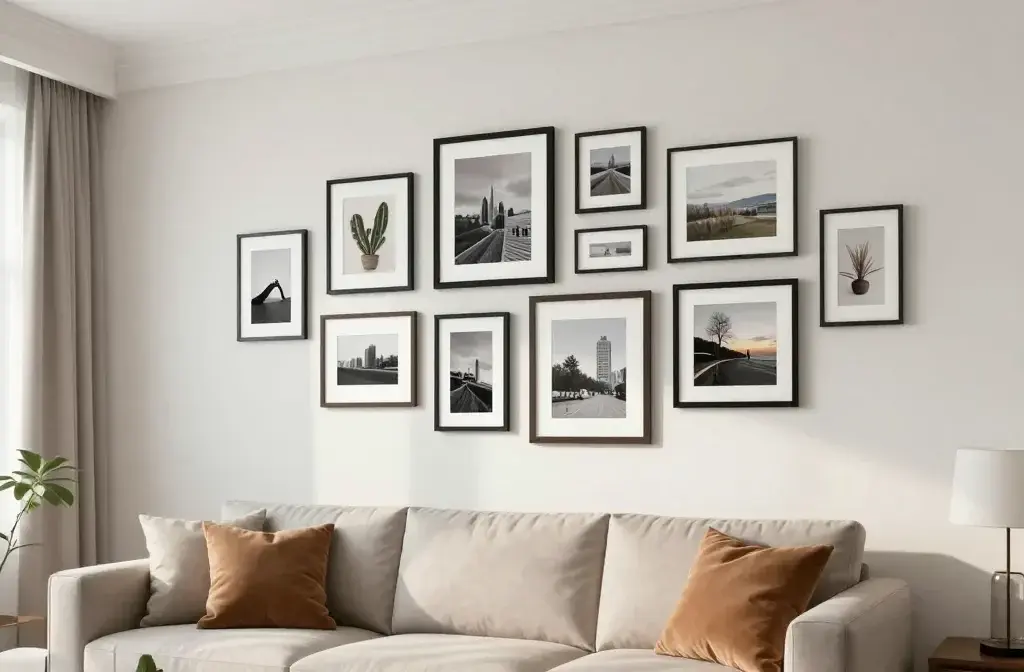
You know that awkward blank wall staring at you every morning? The one you keep meaning to do something about but can’t commit to a single massive piece of art? A gallery wall might be your answer. It’s basically the home décor equivalent of a highlight reel—you get to display everything you love without putting all your eggs (or your entire budget) in one basket.
Planning Your Gallery Wall Layout
Before you start hammering nails into your wall like a caffeinated woodpecker, take a breath. The biggest mistake people make is jumping straight to hanging without any planning. Trust me, those extra nail holes won’t magically disappear, and spackle can only do so much.
Start by measuring your wall space. You don’t need to go full architect mode here, but you should know roughly how much real estate you’re working with. A good rule of thumb? Your gallery wall should take up about two-thirds of the furniture below it. So if you’ve got a sofa that’s six feet wide, aim for a gallery wall around four feet across.
Here’s a pro tip that’ll save you so much headache: lay everything out on the floor first. Seriously. Move pieces around, swap them out, take photos from above. This is your sandbox moment where mistakes cost you nothing but time. You can even trace your frames on kraft paper, tape the paper to the wall, and see exactly how it’ll look before making a single hole.
Choosing Your Frames and Artwork
Now for the fun part—picking what actually goes on your wall. The beauty of a gallery wall is that there are no real rules, but there are definitely some guidelines that’ll make your life easier.
Mix It Up (But Not Too Much)
You want variety, but you also don’t want it to look like a visual garage sale. Pick a theme or color palette to tie everything together. Maybe you’re going all black-and-white photos, or perhaps you’re mixing frame styles but keeping the artwork monochrome. Maybe you’re a rebel who loves color chaos—that works too, as long as there’s some intentional thread running through it.
Frame-wise, you’ve got options. Matching frames create a clean, cohesive look that screams “I have my life together” (even if you don’t). Mixed frames give off more of an eclectic, collected-over-time vibe. Both work! Just make sure you’re repeating at least one element—whether that’s color, finish, or style—to create visual harmony.
What Should You Actually Hang?
Literally anything you love. Photos of your dog? Yes. That vintage concert poster? Absolutely. Your kid’s fingerpainting? Why not! Mix in some unexpected elements like:
- Mirrors to add depth and light
- Small shelves with 3D objects
- Pressed botanicals or textiles
- Typography prints or quotes
- Empty frames (surprisingly chic)
The key is creating different sizes and shapes. All same-sized frames in a grid? That’s fine, but it’s playing it safe. Mixing small, medium, and large pieces creates way more visual interest.
The Hanging Process (Without Losing Your Mind)

Alright, you’ve planned, you’ve chosen, now it’s time to actually put holes in your wall. Deep breath.
Start with your anchor piece—usually the largest or most eye-catching item. This typically goes slightly off-center or at eye level (around 57-60 inches from the floor to the center of the piece). Everything else will revolve around this like planets around the sun.
Work outward from your anchor piece. Keep spacing relatively consistent between frames—usually 2-3 inches works well. Too close and things feel cramped; too far and they look disconnected. Think of it like personal space: close enough to be a group, far enough to breathe.
Tools You’ll Actually Need
Don’t overcomplicate this. Here’s your shopping list:
- A hammer (obviously)
- Picture-hanging nails or hooks
- A level (your phone probably has this as an app)
- Pencil for marking
- Measuring tape
- Painter’s tape or kraft paper for templates
FYI, if you’re dealing with heavy frames, invest in proper wall anchors or find the studs. Nothing kills your gallery wall vibe faster than your favorite print doing a kamikaze dive at 3 AM.
Common Gallery Wall Styles to Consider
Not sure which direction to go? Here are some tried-and-true layouts that actually work.
The salon style is that beautifully chaotic, floor-to-ceiling situation you see in fancy museums. Frames of all sizes packed together with minimal spacing. It looks effortlessly cool but ironically requires the most effort to pull off.
The grid layout is for the type-A personalities out there. Same-sized frames arranged in perfect rows and columns. Clean, modern, and blissfully symmetrical.
The horizontal line approach keeps all your frames aligned at the top or bottom, creating a neat row. Great for hallways or above furniture where you want clean lines.
The organic cluster feels more casual—groupings that spread out from a central point without rigid structure. IMO, this is the most forgiving for beginners because slight imperfections actually add to the charm.
Making Adjustments and Living With Your Wall
Here’s something nobody tells you: your gallery wall doesn’t have to be permanent. Shocking, right? You can swap pieces out, add new finds, or completely rearrange things when you get bored. That’s actually part of the appeal.
If something feels off after you hang it, fix it now. That wonky frame will bother you forever if you don’t address it. Take the extra five minutes to adjust—future you will be grateful.
Consider your gallery wall a living collection. Add birthday cards that make you laugh, ticket stubs from amazing concerts, or photos from recent adventures. The best gallery walls tell a story and evolve over time.
Frequently Asked Questions
How many frames do I need for a gallery wall?
There’s no magic number, but most people find that 5-15 pieces hits the sweet spot. Fewer than five can look sparse unless they’re large statement pieces. More than 15 starts requiring serious planning unless you’re going for that maximalist salon style. Start with what you have and build from there.
Can I create a gallery wall without putting holes in my wall?
Absolutely! Command strips are your friend here, especially for lighter frames. Leaning frames on picture ledges or shelves is another no-hole option that’s super flexible. You can also use adhesive hooks designed for heavier items. Just follow the weight limits—nobody wants a midnight frame avalanche.
What if my frames are all different colors?
Embrace it or unify them. If you love the mismatched look, make sure the artwork inside has some common thread. If it bugs you, a couple cans of spray paint can transform everything into a cohesive collection. Black, white, or gold frames work with pretty much anything.
Should I hang frames with or without mats?
This depends on your style and the artwork. Mats create breathing room and give pieces a more polished, gallery-like feel. Without mats feels more casual and lets you maximize the artwork itself. You can definitely mix matted and unmatted pieces—just make sure the overall vibe stays consistent.
How do I hang a gallery wall on stairs?
Follow the angle of your stairs, keeping frames at a consistent distance from the wall as you ascend. The bottom of each frame should align with an imaginary line that runs parallel to your staircase angle. Use the 57-inch rule from each step to keep things at eye level as you walk up.
What’s the biggest mistake people make with gallery walls?
Hanging everything too high. Seriously, people treat gallery walls like they’re decorating for basketball players. Eye level is your friend. The other big mistake is giving up too early—your first attempt might not be perfect, and that’s totally okay. Adjust, rearrange, and remember that even professionals use templates and planning.
Wrap It Up and Enjoy
Creating a gallery wall isn’t rocket science, but it does require some patience and planning. The payoff? A personalized space that actually reflects your personality instead of looking like a generic hotel room.
Start small if you’re nervous. A cluster of three frames is still a gallery wall and gives you room to expand. The worst that can happen is you need to spackle a few holes—not exactly a catastrophe. So grab those frames collecting dust in your closet, raid some thrift stores for interesting pieces, and turn that blank wall into something worth looking at. Your space deserves better than beige emptiness, and you’ve totally got this.